Chicken Biryani

I watched Rick Stein make this on his TV programme about India and decided to give it a try. We’re not big meat eaters, but we prefer to fill up on protein and vegetables rather than carbs. So I cut the 600g of rice in Steins recipe down to 400g and increased the chicken meat from 600g to one kilo.  If you prefer to use the original recipe you can find it online.

This recipe serves 6-8 and is perfect for entertaining. We didn’t have guests coming which meant there were delicious leftovers to reheat and serve later in the week. I found it easier to mix the saffron and rosewater into the rice rather than sprinkling it over the layers as Stein does. If you don’t have any rosewater don’t worry – the flavour is very subtle so just leave it out. I’ve added a teaspoon of sugar as I always do with savoury sauces, especially if they contain tomato.

A Biryani is supposed to be dry with separate grains of rice. If you prefer more sauce don’t do the final layering in the casserole. Instead boil the rice completely, then drain and serve in one dish. And stop cooking the chicken when there’s more sauce left and serve it in another dish. Alternatively serve the Biryani with another curry which has lots of sauce, such as a vegetable curry.

When we lived in Copenhagen we had an Indian housekeeper called Rajan. He was always telling me that the two steaks or chicken pieces we were having for dinner would feed his family in India for a week. Having inherited my mother’s War mentality I hate to see good food go to waste, so I’m pretty frugal and good at using up leftovers. But by Rajan’s standards all Westerners are wasteful. He would often rock his head from side to side and say “Madam very wasteful”.

Once we had a reception for several hundred people and I needed lots of coriander for one of the dishes. That week the supermarket only had it growing in pots so I bought eight. When Rajan saw me throwing the completely denuded plants into the bin next day he was horrified. Unbeknownst to me he rescued them, took them to his room and kept them on the window sill. It was the middle of winter and far too cold to plant them outside. Two months later in walks Rajan clutching eight flourishing coriander plants, a big smile on his face. It was a real “Ta da” moment, so I made all the right noises and told him how wonderful he was. He was very pleased with himself, this incident being further proof that Madam was indeed very wasteful.

Rajan and I spent many happy hours working together in the kitchen and putting the world to rights. He was often difficult to understand, especially when discussing India-Pakistan politics or cricket, so I usually found it easier just to agree with him. I tried on several occasions to get him to call me Mrs Peek, but he would always reply “Yes Madam”.
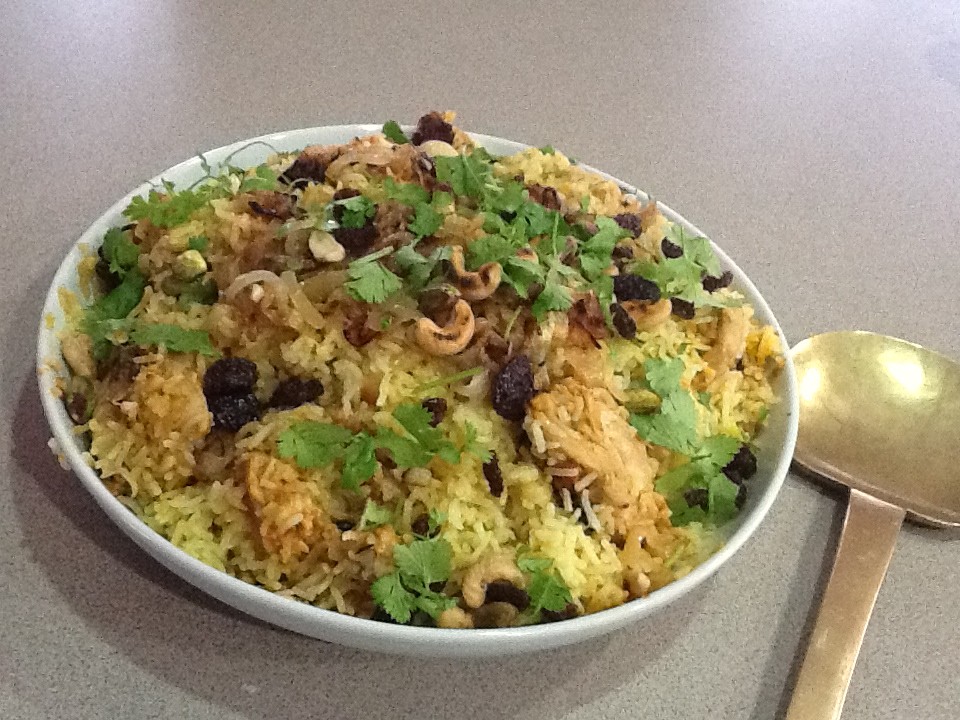
Chicken Biryani400g basmati rice, soaked in cold water for an hour
Marinade:
1 cup plain thick yoghurt
2-3 green chillies (mine were 10cm+ long so I used 2)
1 tsp chilli powder (I substituted a rounded tsp of Sambal Oelek)
6 cloves garlic, crushed
1 heaped Tbs grated fresh ginger
1 tsp ground coriander
½ tsp ground turmeric
1 kg boneless, skinless chicken thighs, cut in halves
Fried Onions:
1 cup vegetable oil
3 medium onions, thinly sliced
Remaining ingredients:
10 whole cloves
1 cinnamon stick, broken
5 cardamom pods, bruised with a rolling pin
2 bay leaves
1 tsp cumin seeds
2 medium tomatoes, chopped
1 tsp salt
1 tsp sugar
100g clarified butter or ghee, melted
Pinch saffron soaked in 4 Tbs warm milk for 15 mins
2-3 tsp rosewater
To garnish:
A handful of dry roasted cashews and/or pistachio nuts to garnish
A handful of raisins (not in Stein’s recipe but in many others)
Fresh coriander, roughly chopped

Mix chicken with marinade and put aside for an hour or more. Drain rice and cook in plenty of boiling salted water for 5-7 minutes or until just tender but still firm. Put aside to drain. Heat oil in a wok or large frying pan and cook the onions for 10-15 mins or until golden brown and crispy. Drain on paper towels.

Remove all but 3 Tbs oil from the pan. Keep the rest of the oil for another use. Cook the whole spices for a minute then add the chicken and its marinade, the tomato and salt and cook, stirring and turning the chicken from time to time over a moderate heat for 20-30 minutes, or until chicken is tender and liquid has mostly disappeared. Stein says to add a splash of water to the sauce if it starts to catch before the chicken is cooked, but I didn’t find this necessary.

To assemble the dish, mix saffron mixture and rosewater into the cooked rice. If you don’t have any saffron, substitute 1-2 teaspoons of turmeric. Place half the clarified butter or ghee and 3 Tbs water in a large heavy casserole with a well fitting lid. A Le Creuset-type is perfect. Spread over a third of the rice, then half the chicken and a third of the fried onions. Repeat with another third of rice, the remaining chicken, another third of the onions and finally the rest of the rice. Keep the remaining third of fried onions to garnish. Drizzle the remaining clarified butter or ghee around the edges of the rice so it drips down the sides and prevents sticking. Put the lid on the pot and place on the stove on a high heat. Lift up the lid to check and as soon as you see steam rising put the lid back and turn the heat to very low for 30 minutes.

Tip the Biryani onto a large serving platter, making sure you scrape up the crispy bits from the bottom of the casserole, as they are particularly delicious. Garnish with the remaining fried onions, the nuts, raisins and coriander.

A side dish of raita – a yoghurt and cucumber dish for which there are plenty of recipes online – goes well, as does a dish of fruit chutney.

Serves 6-8
Sticky Chilli Chicken

You may have noticed that Café Cat has been quiet for the past 3 weeks while I was on a business trip to Chile. This involved catching up with lots of friends – rather too many lunches, dinners and pisco sours – the Chilean national tipple. But life’s too short to avoid occasional periods of over-indulgence!

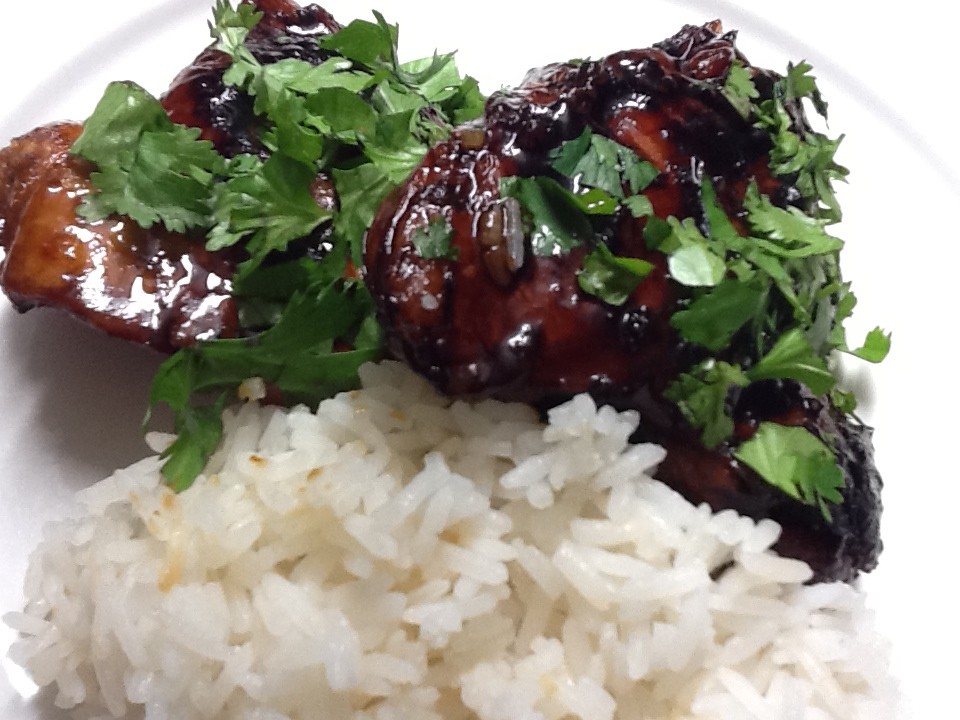
For some reason jet-lag is always better coming back from Chile to Australia than it is going. Even so, in the first few days after returning from somewhere which is 14 hours behind AEST, I am not at my most creative. So we’ve been eating quick and easy, tried and tested dishes such as this one for Sticky Chilli Chicken. The original recipe came from Donna Hay – I’ve just cut down a bit on the sugar and the soy sauce. It may sound like a lot of chillies, but the end result is not very hot. Any leftovers are nice cold.

Sticky Chilli Chicken1.5kg chicken pieces (I use thighs)
Chilli Sauce:
3 red chillies, seeded and finely chopped
1 Tbs grated ginger
2 cups water
1/3 cup soy sauce
1/3 cup sugar
½ cup vinegar
½ cup chopped coriander

Place all ingredients for sauce except the coriander in a deep frying pan which has a lid and simmer for 3 minutes. I use an old-fashioned electric frypan. Trim chicken pieces and remove skin if liked. Add chicken to pan, cover and cook for half an hour, turning from time to time. Remove lid and continue to cook for 20-25 minutes, turning chicken from time to time until the sauce has become sticky and the chicken is well coated. Watch carefully towards the end as you don’t want the sauce to completely dry up and burn. Add coriander and serve with steamed rice.

Serves 4

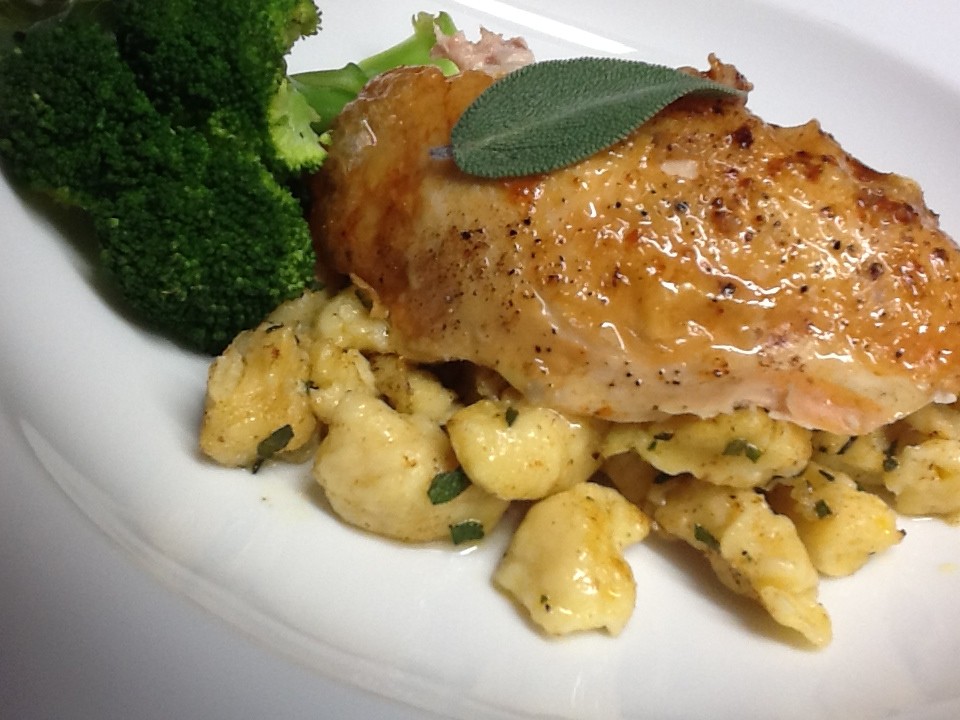
Roast Chicken with Spaetzle & Burnt Sage Butter

Made from flour and eggs and cooked in boiling water, spaetzle is the German equivalent of pasta. A bit like gnocchi without the mashed potato. If you like making spaetzle it’s worth investing in a spaetzle-making gizmo. They’re not expensive – I bought mine for about $20 including postage from Fishpond.

I first ate spaetzle in Austria as a delicious dessert called Apfel Spaetzle. The little morsels of cooked dough had been stir fried in butter with sliced apples and spices, then doused with icing sugar. It might even have been stuck under a griller as there were some crispy crunchy bits.

It’s looking a bit wilted and sad, but my sage bush seems to be surviving the winter frosts. Although the recipe says burnt butter, it should actually be nut brown rather than burnt.

Roast Chicken with Spaetzle & Burnt Sage Butter1 whole chicken
25-30g butter
2 Tbs chopped fresh sage
Spaetzle:
2 eggs
1 cup flour
1 tsp salt
3-4 Tbs milk

Preheat oven to 180ºC. Roast the chicken for an hour to an hour and a half, depending on size, seasoned with salt and pepper and a knob of butter.

Meanwhile, make the spaetzle. Mix eggs with flour, salt and enough milk to make a sticky mixture. Half fill a large pan with water and some salt and bring to the boil. Push the mixture through an oiled spaetzle maker into the water in batches. Alternatively you can drop small pieces of dough, about half a teaspoon at a time, into the water or push the dough through the holes of a metal collander. When the little dough balls rise to the top they are done. Remove with a slotted spoon to a collander.

When chicken is almost ready, heat butter in a frying pan. Allow it to brown, but be careful it doesn’t burn. Add the sage and cook for a minute or so, then add the spaetzle and cook for another minute, stirring, until they have absorbed the butter.

Divide spaetzle between 4 plates. Carve chicken and arrange on top of each serving. If liked drizzle some of the chicken pan juices over the top. Serve with a steamed green vegetable such as broccoli.

Serves 4

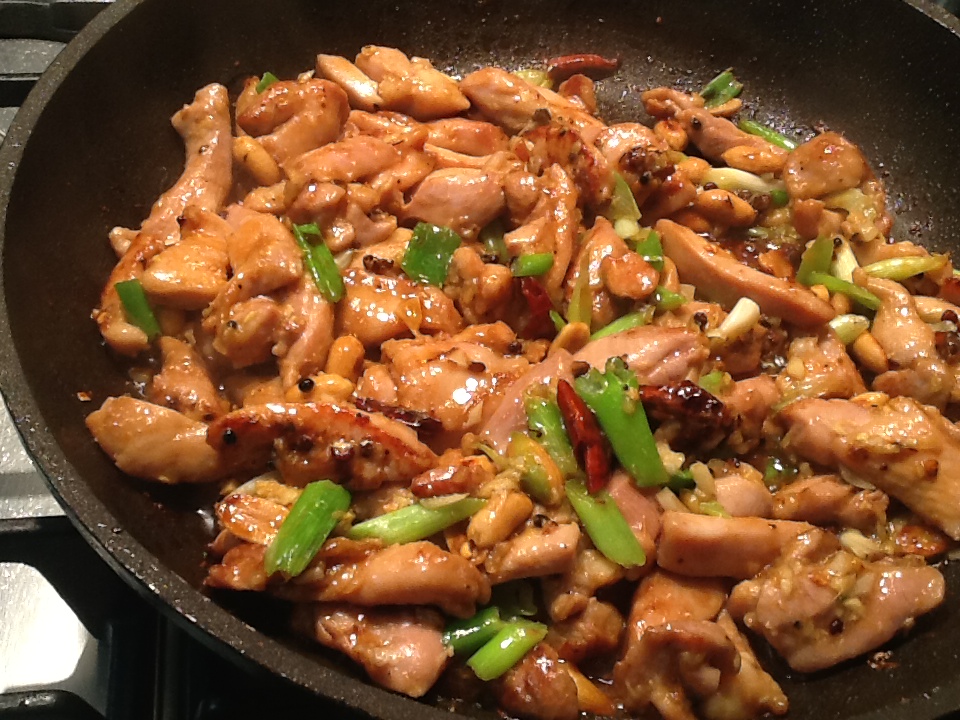
Gong Bao Chicken

Sometimes translated from the Chinese as Kung Pao rather than Gong Bao, this stir fry from the province of Szechuan in central west China is simple but delicious. The recipe I used called for 4 dried chillies, but one or two would have been enough for us. I’m not a wuss (good Aussie term for a wimp for those who don’t know) when it comes to chillies, but dried ones seem to pack more of a punch than fresh ones. As it says on Wikipedia “the use of hot and numbing flavours is a typical element of Szechuan cooking”. Clears the sinuses.

Gong Bao Chicken500g boneless, skinless chicken thighs
1 Tbs cornflour
4 Tbs soy sauce
1/3 cup unsalted peanuts or cashews
2 Tbs oil
2 tsp Szechuan peppercorns
1-4 dried red chillies, to taste, roughly chopped
3 cm piece fresh ginger, peeled and finely chopped
2 cloves garlic, peeled and finely chopped
4 spring onions, trimmed & finely sliced on the diagonal
Steamed rice to serve

Slice chicken and mix with the cornflour and 2 Tbs of the soy sauce. Leave to marinate for about 15 mins. Heat a dry pan and toast the nuts for a few minutes, stirring, until golden. Remove and set aside. Heat oil in wok or large frying pan. Add dried chillies and peppercorns and cook, stirring for 2-3 mins. Turn up heat and add chicken. Cook, stirring, until chicken is cooked on both sides. Add ginger, garlic, spring onions and nuts and continue to cook, stirring for 2-3 mins. Add remaining 2 Tbs soy sauce and serve with steamed rice.

Serves 3-4

Note: if you like a touch of sweetness, add 1-2 tsp brown sugar at the end with the soy sauce, or use kecap manis, which is a sweetish soy sauce.

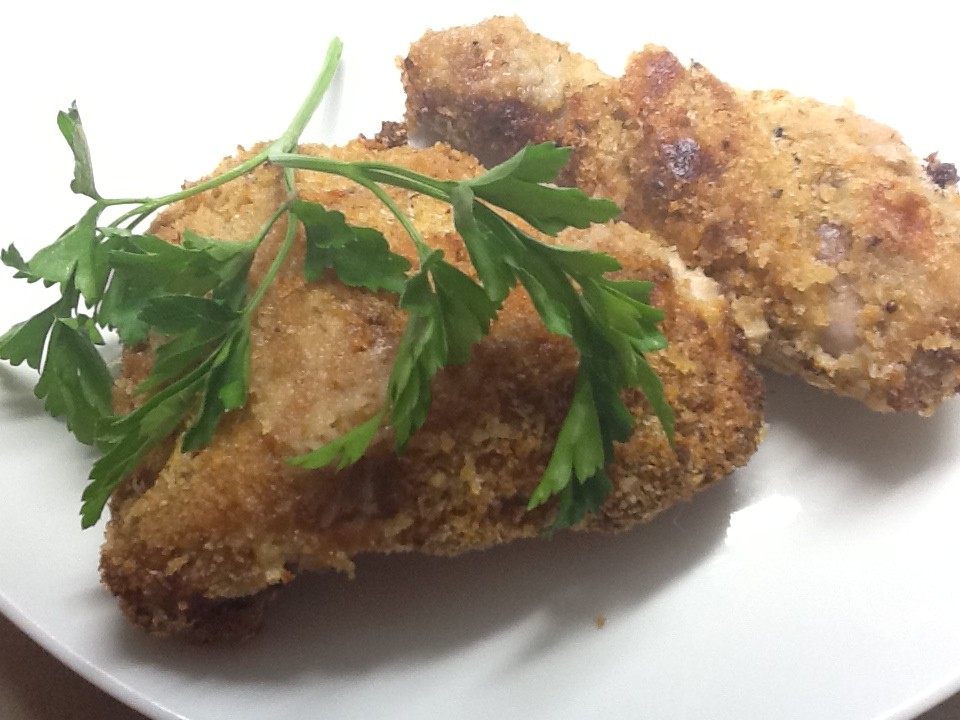
Healthy Oven-Baked KFC

Served with oven chips and coleslaw or a mixed salad this healthy version of Kentucky Fried Chicken – baked in the oven, rather than deep fried – is popular with kids. It’s not haute cuisine as you can see from the photo, just a very basic, economical family meal. It featured regularly in our house when the kids were growing up.

A salsa made from diced fresh mango or peach, red onion, fresh ginger, Thai sweet chilli sauce and chopped coriander is a nice addition for the adults. A diced avocado is an optional addition.

Healthy Oven-Baked KFC1 packet corn chips (see note below)
1 packet breadcrumbs (preferably Japanese Panko crumbs)
1 kg chicken pieces with skin
½ cup plain flour
1-2 tsp powdered chicken stock or salt or celery salt
Freshly ground black pepper to taste
3 tsp of dried herbs and spices of your choice (paprika, oregano etc)
1 egg plus 2 Tbs milk, beaten
Spray oil (olive, canola, whatever you use)

Preheat oven to 180°C. Place some of the corn chips in a food processor and process to make crumbs. Mix with the packaged breadcrumbs in a proportion of about two to one. Place about 2 cups in a shallow bowl and keep the rest in a sealed container for another time.

Mix flour with salt, pepper, herbs and spices in another shallow bowl. Be generous with the chicken stock powder or salt – it needs it. Mix the beaten egg and milk in a third bowl. Coat chicken pieces with seasoned flour, then with beaten egg and lastly with the crumb mixture, patting it on well. Place chicken on a baking try lined with non-stick baking paper – not necessary but saves on washing up. Spray chicken lightly with oil. Bake for about about 45 mins, turning once and spraying the other side with oil about halfway through. The chicken is ready when it’s golden brown and cooked through – test with a sharp knife.

Serves 4-6

Note: if you don’t have corn chips substitute cornflakes.

Oven Chips: cut potatoes into thick chunky chips and cook in boiling salted water for 8-10 minutes or until half-cooked. Drain and pat dry with paper towels. Place in a bowl with a small slug of olive oil, mix to coat, then add a shake of plain flour and turn again to coat. Arrange chips in a single layer on a tray lined with baking paper, sprinkle with coarse salt and bake for 45 minutes on the shelf above the chicken, or until golden brown. The flour is optional but gives the chips a nice crunchy coating.

Chicken and Squid with Rice Noodles

This recipe is based on one by Neil Perry. The original recipe only had half a cup of chicken stock. I added extra liquid to make it more of a soupy stir-fry. I also added a touch of sugar  – as per my grandmother’s rule of always adding some sugar to anything savoury and some salt to anything sweet – and some ginger.

It’s a delicious, light and easily-digested supper which takes no time at all to make. If you don’t like squid (which I bought in Woolies) just increase the chicken.

Chicken and Squid with Rice Noodles2 Tbs oil
3 boneless chicken thighs, thinly sliced (or 2 breasts)
2 cloves garlic, crushed
1 beaten egg
250-300g fresh rice noodles (I used 220g pack of Kan Tong Shelf Fresh)
3 Tbs soy sauce
1 cup chicken stock
1 squid tube, cut into thin rings
1 bunch Chinese greens e.g. Bok Choy, washed and thickly sliced
2 cups beansprouts
salt and freshly ground pepper to taste
1 tsp sugar
1 Tbs grated fresh ginger
To serve:
¼ cup crushed roasted peanuts
2 spring onions, finely sliced on the diagonal

Heat oil in a wok and stir fry chicken for 3-4 minutes, then remove with a slotted spoon. Add garlic and cook for a minute, stirring, then add the egg. Continue to stir-fry as you add the noodles, soy sauce and chicken stock. Return chicken to the pan with squid, ginger and greens and continue to stir-fry for 2 minutes or so. Don’t overcook or the squid will be tough. Add sugar, season to taste and at the last minute add the beansprouts, plus a little more water if necessary. Serve in shallow bowls garnished with the peanuts and spring onions.

Serves 4

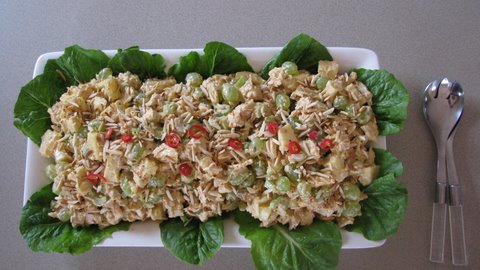
Curried Chicken Salad

Over the years I’ve stopped making some of the recipes I collected in my teens because my taste has changed, or maybe they were never that special to begin with and new ones have taken over as favourites. Others have evolved over the years with slight modifications and improvements – cutting down on fat or sugar, or smartening up the presentation.

This curried chicken salad, which I’ve been making for decades, falls into the latter category. When I’m asked to bring a plate and take this dish I am always asked for the recipe, so I can’t imagine I will ever cross it off my repertoire. The original version used canned pineapple, which was very popular in the UK when I was growing up.  I don’t think I ate a fresh pineapple until I was well into my 20s, but everyone had a few cans in the pantry to add to coleslaw, serve with grilled ham steaks or add to fruit salads.  Nobody needs to buy canned fruit these days with such a wide selection of fresh fruit available.

This dish makes a perfect addition to a cold buffet and is a great way to make one roast chicken serve a crowd. It’s easy to double, triple or quadruple, any leftovers go down well the following day and I’ve also made it using leftover roast Turkey from Christmas lunch. The dressing and all the ingredients can be prepared the day before. It looks nice in individual servings, piled onto a large lettuce leaf or in a whisky tumbler lined with lettuce.  If you want to be really swish, serve the salad in hollowed out fresh pineapple halves, with the green tufty bits left on and of course use what you’ve dug out in the salad. Garnishing with red chilli brings this dish into the 21st century.

Curried Chicken Salad

Meat from one large roast chicken, cut into bite-sized pieces
1½ cups thinly sliced celery (sliced on the diagonal looks nice)
2 cups seedless grapes
1 cup fresh pineapple cubes
¾ cup flaked almonds or unsalted cashew nuts, roughly chopped
To garnish: Thin slivers of red chilli or red capsicum
Dressing:
1½ cups mayonnaise (preferably home-made)
2 Tbs lemon or lime juice
2 Tbs soy sauce
2 Tbs chutney or relish
1 Tbs curry powder or paste
1 Tbs grated onion

Dressing: Chop chutney if it’s very chunky. Mix all ingredients together and refrigerate for several hours or overnight.

Toast almonds or cashews in a dry frying pan, stirring frequently, until golden, then remove from pan and cool. Prepare the chicken, grapes, celery and pineapple and refrigerate each separately. Recipe can be prepared to this stage up to 24 hours before serving.
If you have time, mix chicken with dressing and refrigerate for a couple of hours for flavours to blend. Mix in celery, grapes and pineapple just before serving.

To serve, mound the salad onto a flat serving platter with lettuce leaves around the edge.  Or omit the lettuce and pile the salad into a serving bowl. Sprinkle with toasted nuts and garnish with the chilli.

Serves 6 as a main course or at least 12 as part of a buffet.

Chicken Terrine with Herbs and Pink Peppercorns
A terrine is handy to have in the fridge over the holiday period.  Serve as a light lunch or starter with salad, or as part of a buffet.  My terrine dish is made from glazed pottery and holds 3 liters.  It has a lid and was made in France.  A metal or silicone loaf pan will do.  You can use pink peppercorns in brine or the dry ones which I buy from The Essential Ingredient.  I’ve put “About 700g of chicken mince” because if you buy it prepacked and it happens to be 100g more or less, it doesn’t matter, throw it all in.  Same with the breasts.

When you tip it out there will be a certain amount of jelly surrounding the terrine.  You will probably want to throw this away, although our golden retriever thought it was quite delicious mixed in with his boring dry biscuits for dinner!

Chicken Terrine with Herbs and Pink Peppercorns

5-8 slices of prosciutto or pancetta (enough to line your terrine)
About 700g chicken breast meat
About 700g chicken mince
1 small onion or a couple of shallots, very finely chopped
1 cup cream
1 egg
Salt and freshly ground black pepper to taste
1 Tbs pink peppercorns
3-4 Tbs finely chopped herbs (I used a mixture of parsley and marjoram)
2 Tbs brandy

Preheat oven to 200°C.  Lightly oil the terrine dish, then line it on all sides with a single layer of pancetta or prosciutto.  Trim chicken breasts of any fat, then cut into 2-3cm cubes.  Use your food processor to chop the herbs and mix with the chicken breast, stirring to coat thoroughly and adding salt and pepper to taste. Mix chicken mince with remaining ingredients, using food processor to chop the onion or shallots.  When thoroughly mixed place half the mixture in the terrine, spreading evenly, then arrange all of the chicken breast cubes on top, then the rest of the mince mixture.  Press down well, cover terrine with the lid or with a piece of foil.  Place in a large dish such as a lasagne dish or a baking pan and pour in enough boiling water to come halfway up the sides of the terrine dish.  Bake for an hour, then remove from the oven, cool thoroughly, then refrigerate overnight.  Some terrines need to be weighted overnight, but I found this didn’t need it.  To serve, loosen the terrine and tip out, then cut into slices.  If it’s difficult to remove, you might need to dip the bottom of the terrine into boiling water.  If liked, garnish with some extra pink peppercorns and serve with Sweet Mustard Sauce.

Cuts into about 10 thick slices.

Sweet Mustard Sauce
1 Tbs English mustard
1 Tbs Dijon mustard
1 Tbs grainy mustard
1 Tbs sugar
1 Tbs vinegar (white or cider)
3 Tbs cup olive oil

Place all ingredients in a jar with a lid and shake well.  Leave overnight for the sugar to dissolve.

Note: this mustard sauce goes very well with Gravlax for which I would add a couple of tablespoons of finely chopped dill and 3-4 Tbs mayonnaise (preferably home-made) to make the sauce less hot.

Sticky Honey Chicken

This weekend we went to Woodlands, our 46 hectare rural property at Hereford Hall, 40 minutes out of Braidwood, New South Wales.  Sometimes we invite friends or family to join us, but this weekend Matthew wanted to prepare the area around the house for planting a lawn and sow the seeds, so there was no time for socialising.

Browsing through this month’s Delicious magazine before we left, I read a letter from a reader which mentioned a recipe for Sticky Honey Chicken with Ginger and Garlic by Rick Stein. It had apparently appeared in the magazine many moons ago and the reader said it was so good she was still making it regularly.  I decided to find it on the internet, print off a copy and make it over the weekend.  Here is my slightly adapted version.  I cut out the olive oil – the chicken was fatty enough without it – and added fresh coriander as a garnish.  I also cut down a bit on the quantities in the glaze and used only chicken thighs, because I’m not mad about drumsticks.  The cayenne pepper gives the sauce a nice kick and any leftovers are nice cold.

Rick Stein’s Sticky Honey Chicken with Ginger and Garlic

8-12 chicken pieces – drumsticks, thighs etc, skin left on
juice of one small or ½ large lemon
1 tsp cayenne pepper
1 tsp salt
Glaze
1½ Tbs honey
2-3 cm fresh ginger, grated
2 Tbs HP sauce (I substituted BBQ sauce)
1 Tbs Worcestershire sauce
2 Tbs tomato sauce (ketchup)
1 Tbs tomato puree
2 Tbs red wine or cider vinegar
2 Tbs soy sauce
2  large garlic cloves, crushed
fresh coriander to garnish

Preheat oven to 200°C. Trim chicken of any excess fat or skin.  Place in a shallow ovenproof dish in one layer.  Sprinkle with lemon juice, cayenne pepper and salt. Turn chicken pieces until well coated. Cover and set aside while you mix the glaze.

Make glaze by mixing all ingredients together. Roast chicken for 15 minutes skin side up. Turn chicken pieces over, spoon over half the glaze and roast for another 15 minutes.  Turn over so they are skin side up again, spoon over remaining glaze and bake for a further 10-15 minutes or until nicely browned and cooked through.  Garnish with coriander. Serve with steamed rice, with a knob of butter added and a steamed green vegetable or green salad.

Serves 4-6

Chicken Satay

When we lived in Kuala Lumpur in the early 1980s, The Pink Tablecloths, our favourite street cafe, gave me their recipe for satay with peanut sauce – a dish which is popular in both Malaysia and Indonesia.  I haven’t made them for quite a while, but a week in Bali has reminded me how tasty they are.  You can use any meat you like, but I prefer chicken.  The original recipe used all peanuts, but I have substituted half for peanut butter, which I find gives a creamier result.

Chicken Satay The Pink Tablecloths

1 kg chicken meat (thighs are best)

Marinade:
3 cloves garlic, crushed
1 small to medium onion, grated
1 heaped Tbs palm sugar or brown sugar
2 Tbs lemon juice
1 Tbs tamarind juice or paste
3 Tbs soy sauce

Cut meat into cubes or strips and thread onto wooden skewers which have been soaked for half an hour in cold water, so they don’t burn. Mix marinade and pour over the meat. Leave for at least 30 minutes then cook over a charcoal grill or under a grill. Serve with Satay Sauce, steamed rice and a small side salad of sliced cucumber and onion.

Serves 4-6

Note: beef, lamb or pork can be used instead of chicken in this recipe.

Satay Sauce
½ cup salted peanuts
½ cup peanut butter
1 small onion, peeled
1 can coconut cream
2 Tbs palm sugar or brown sugar
1-2 smal red chillies, seeded and chopped (to taste)
2 tsp lemon peel, or lemon grass, chopped
Soy sauce to taste
Juice of half a lemon or lime

Process all ingredients together in a food processor until you have a thick, slightly chunky sauce. Heat until thick in a small saucepan.  Serve at room temperature.  Any leftover sauce can be frozen for next time.