I began collecting recipes when I was at school. Some of the recipes in my large collection have been in my family for generations, others were passed on by friends and chefs around the world. Many have been adapted over the years to make them lighter or update their presentation. I’ve served them to royalty, PMs and other VIPs and there have been no complaints. I hope you are inspired to make some of them.
Matthew’s not mad about bananas or coconut, so I usually avoid using them in cakes. Sometimes I sneak them in and hope he won’t notice.
This recipe only uses one banana, so the flavour isn’t overpowering. It’s delicious served fresh on the day it’s made. Or you can keep it in the fridge, well-wrapped, for up to a week and serve it toasted.
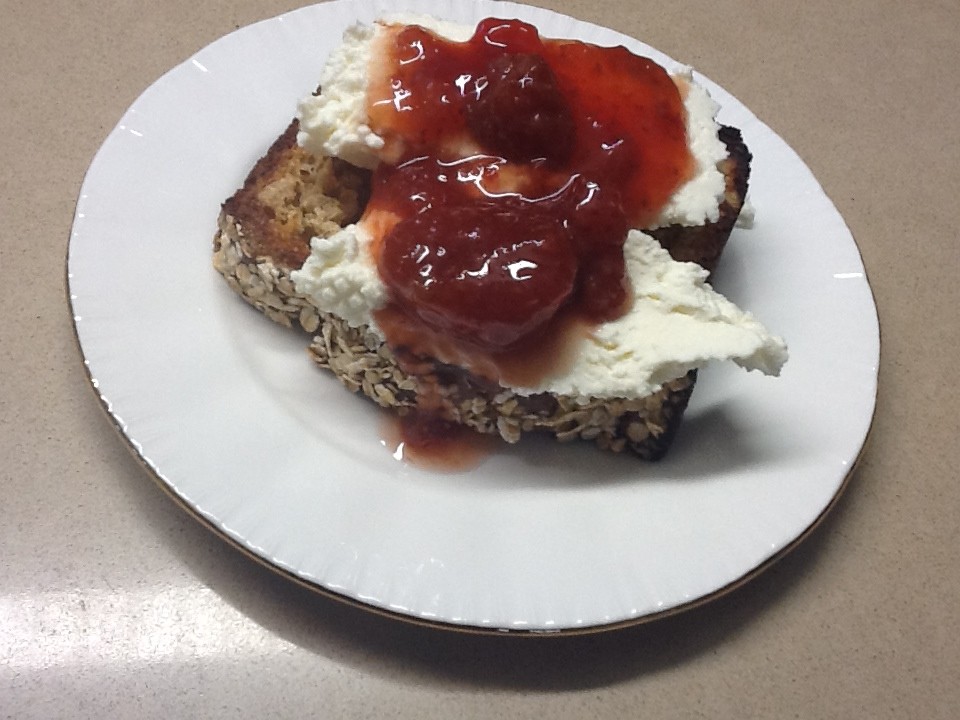
As it doesn’t contain any fat this banana bread is quite healthy, eaten on its own. But of course it’s even nicer with things on top! Serve it toasted for breakfast, topped with butter and jam; with a sliced banana, ricotta cheese and a drizzle of honey or with home made strawberry jam and ricotta as shown in the photo. I like to freeze the individual slices wrapped in plastic wrap so they can then be toasted from frozen and are ready in a jiffy.
1 ripe banana 2eggs 1 cupbuttermilk (see note below) 2½ cupsself-raising flour, sifted ½ cupoats ½ cupdesiccated coconut ¼ to ½ cuphoney, to taste 1 tspvanilla essence ½ cupsunflower kernels (shelled sunflower seeds)
Preheat oven to 180°C. Grease a large loaf tin and line the bottom with baking paper. Place banana in food processor and process till smooth. Add remaining ingredients except sunflower kernels and process just enough to mix. Add sunflower kernels, tip into prepared loaf tin and smooth the top. Sprinkle with a few more oats, press them in, then bake for an hour, or until well-risen, golden brown and a skewer inserted in the middle comes out clean. Can take up to an hour and a quarter, depending on your oven. Cool and serve fresh or toasted. Can be frozen.
Makes one loaf
Note: if you don’t have buttermilk substitute half milk and half plain yoghurt. If you don’t have any sunflower kernels, double the oats or the coconut.
When I worked for the British Mission to the UN in Geneva, located on the 5th floor of a large building on the Rue de Vermont, there was a patisserie at street level. By mid-morning irresistible smells came wafting up through the office window, so someone was dispatched to buy a few slices of apple tart, still warm from the oven, to keep us going till lunch time. Those were the days when I could do that on a regular basis, without it going straight to my hips!
Before I left Switzerland I asked the owner if she would part with the recipe and she was happy to do so. Puff pastry is a bit of a pain to make, so I usually buy it. That is until I discovered Nigella Lawson’s food processor version which is a cinch to make and of course much nicer. Actually any pastry will do and you may prefer to use shortcrust pastry, bought or home-made.
Nigella’s Food Processor Puff Pastry
2 cupsplain flour Good pinch of salt 250gbutter, cut into ½ cm slices
2 tsplemon juice 4-5 Tbs cold water
Filling: 1 kg eating apples, peeled and sliced 2 eggs 2 Tbsplain flour or almond meal ½ cupmilk (or half milk and half cream) 2 Tbssugar 2 Tbsunsalted butter Extra sugar
Pastry: place flour, salt and butter in food processor. Pulse until butter has been cut into small pieces but is still visible. With the motor running add the lemon juice and enough water for the pastry to start to stick together, then stop immediately. Don’t process for long because you want to keep the pieces of butter intact.
Tip out the sticky crumbs and with floured hands form them into a neat rectangle about 15 cm long and about half as wide. Wrap in plastic wrap and refrigerate 30 mins. Remove from fridge and roll pastry until the long side is twice as long. Fold one end into the middle and the other end over it to the edge, like an envelope. Turn pastry so the open ends are at the bottom and top, then roll again into a long rectangle. Repeat the folding and rolling twice, but the last time don’t do the final rolling – leave it with the open ends. Wrap in plastic wrap and refrigerate several hours or up to three days. Can be frozen.
Preheat oven to 180°C. Remove pastry from fridge and, unless you’re working on a hot summer’s day, let it stand for a short while, so it’s not rock hard. Roll out on a floured surface and use to line a rectangular metal Swiss roll or slice tin, trimming off any excess. Mine is 35x25cm. Arrange rows of overlapping apple slices over the base. Be generous – the pie should be very full with the apple slices standing almost upright.
In a small bowl with a fork or balloon whisk, mix egg with flour (or almond meal) and sugar, then gradually mix in milk/cream. Brush over the apples to moisten them, then pour the rest over. Tilt tin to ensure it reaches the corners, then dot the apples with very small pieces of butter and sprinkle lightly with extra sugar. Bake for about an hour or until well browned, almost burnt in places, to give it that authentic European patisserie look. If liked shake over some extra sugar and serve warm, just as it is, or with cream or ice cream, or both!
When we were living in Paris I was a member of a Franco-Australian group which met once a month. We took it in turns to host the meeting which took the form of afternoon tea, with an hour speaking in English followed by an hour speaking in French. When it was her turn to host the group Dominique made this very unusual Lemon Tart. The crust is quite thick but it’s like a delicious shortbread that blends in with the filling, so it doesn’t seem to matter.
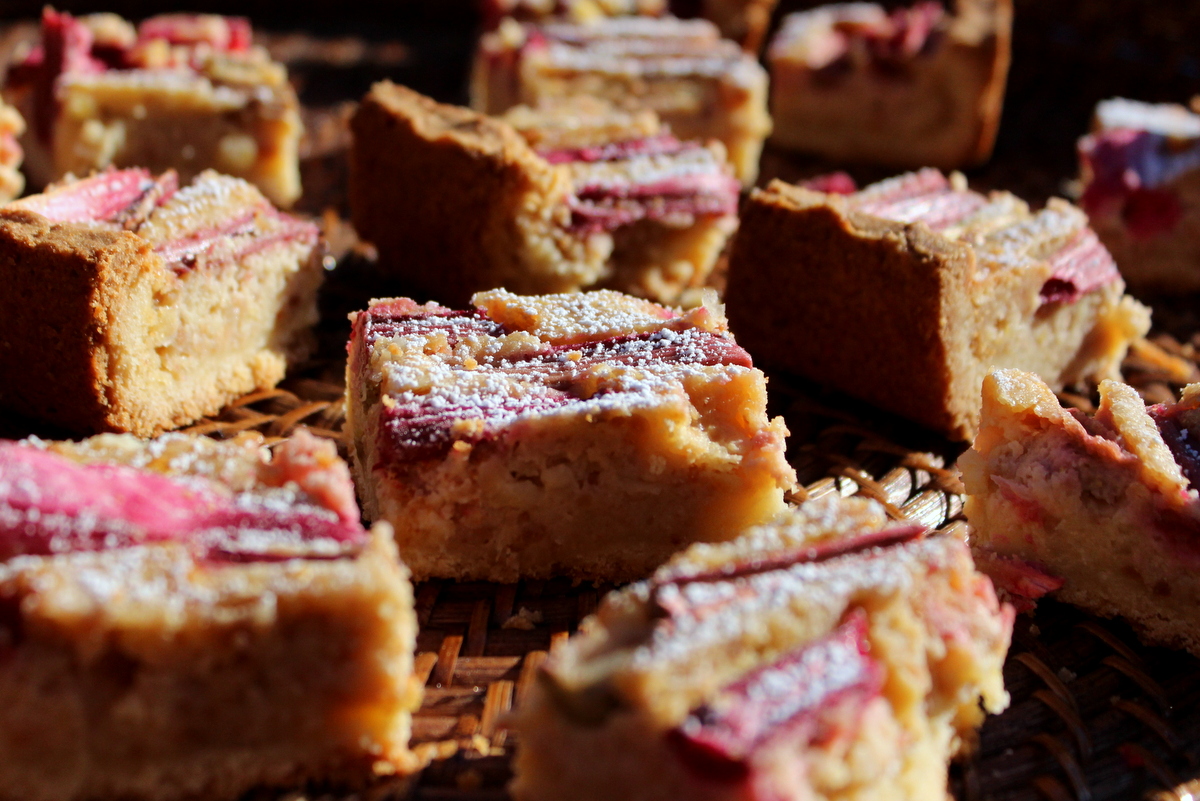
The recipe fills a normal 20-25cm (8-10 inch) round pie dish. In the photo I have used a rectangular meat-roasting pan (26x33cm) and increased all the ingredients by about a quarter. I wanted something to cut into squares to serve a large crowd. I have put those quantities, for a bigger pie, in brackets. The original recipe was sprinkled with flaked almonds, but I used rhubarb instead because it needed using up!
Pastry:
200g marzipan (at room temp) (250g)
200g butter (at room temp) (250g)
2 cups plain flour (2½ cups) Filling:
100g ground almonds (125g)
3 large eggs (4)
1 cup sugar (1¼ cups)
1 large lemon (2 smaller ones)
pinch salt
1 Tbs flour (1 heaped Tbs)
1 cup cream or sour cream (1¼ cups)
50g flaked almonds (80g)
Pastry: Preheat oven to 170°C. Process marzipan and butter in the food processor until well combined, then add the flour and process till it starts to stick together. Tip the sticky crumbs into a tart tin or large quiche dish. Using fingertips, press pastry all over the bottom and up the sides to form the crust.
Filling: No need to wash the food processor to make the filling. If almonds are not already ground, put them in the food processor first and process till fine. Cut the lemon into quarters, remove the stalk and pips then add to the food processor with the sugar, eggs, cream, flour and salt.Mix until fairly smooth.Pour into the pastry case and sprinkle the flaked almonds all over the top. Bake for 40-60 minutes until deep golden brown. If the edges start to get too brown, cover them with a collar of foil. Serve with cream as a dessert or for afternoon tea, dusted with icing sugar.
Serves 8-10
Note: This tart is nicer if you let it get slightly over-cooked so the edges become crunchy.
Variation: omit flaked almonds and top pie with a bunch of rhubarb, washed, trimmed and cut into 6-cm lengths.
A proper Italian pizza has a thin, crispy crust and minimal topping. Nothing remotely like the thick, soggy versions sold in many fast food chains. The Associazione Verace Pizza Napoletana says that when cooked a pizza base should be no more than 4mm thick at the centre, though it will be thicker around the edges. And they should know, they invented them.
When our kids were growing up pizza featured regularly on the menu. The pizza delivery motorbikes never came to our house because my view is that anything home-made is better than the bought version, not to mention cheaper. At the time our offspring thought they were deprived, but now they have their own families and also make their own.
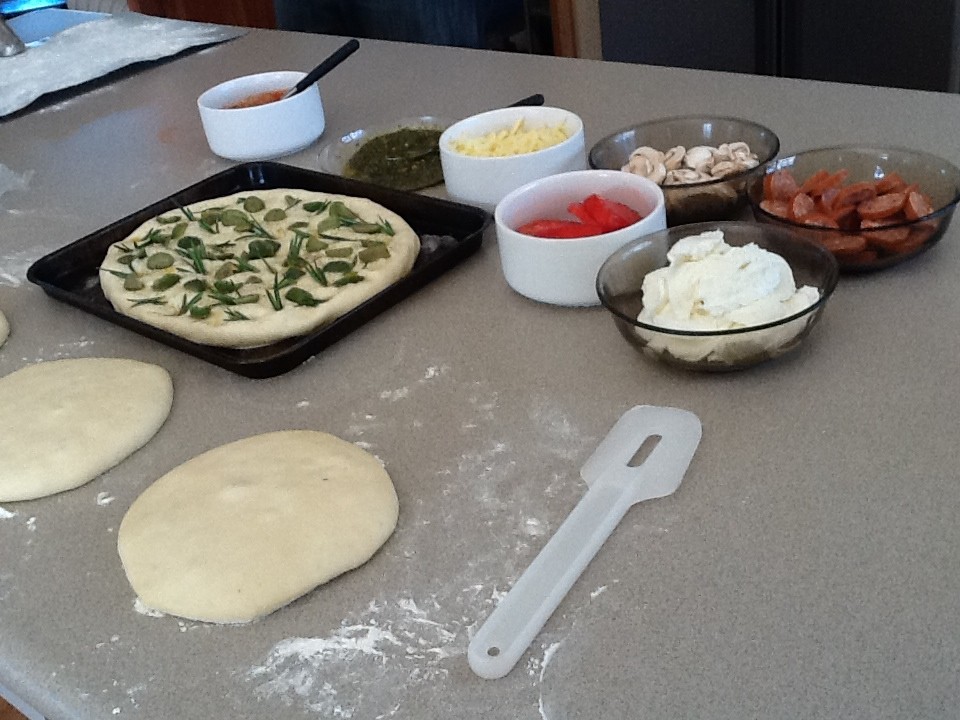
For a larger group make 3-4 times the recipe and form the dough into balls. Have the toppings ready in small dishes and let people choose their own. With a salad and a bottle or two of vino you’re all set for a casual meal which appeals to all ages.
15g fresh yeast or 7g dry yeast
1 tsp sugar
½ tsp salt
2 cups plain flour (preferably 00)
1 Tbs olive oil
½ to ¾ cup warm water
Mix ½ cup warm water with yeast and sugar. Leave for 10 minutes. Sift flour and salt into a bowl, add oregano, oil and yeast mixture. Mix well, adding more warm water until you have a firm, not sticky, dough. If preferred make in a food processor or in a mixer with a dough hook.
Turn dough onto a floured surface and knead for a couple of minutes until smooth and springy. Form into a ball, place in a lightly oiled bowl and turn to coat with oil. Cover and leave at room temperature for an hour, or until doubled in size. Alternatively, cover and refrigerate overnight to prove more slowly.
Preheat oven to its highest temperature. If using, put pizza stone in the oven to get really hot. Knead dough lightly and form into a ball (or two balls) and leave, covered with a tea towel for about 20 mins or until doubled in size.
To assemble pizzas place a ball of dough on a lightly oiled pizza pan and press out to size using oiled fingers, working from the middle out. If using a pre-heated pizza stone, or a wood-fired pizza oven, press dough out into a large round on a well-floured pizza paddle.
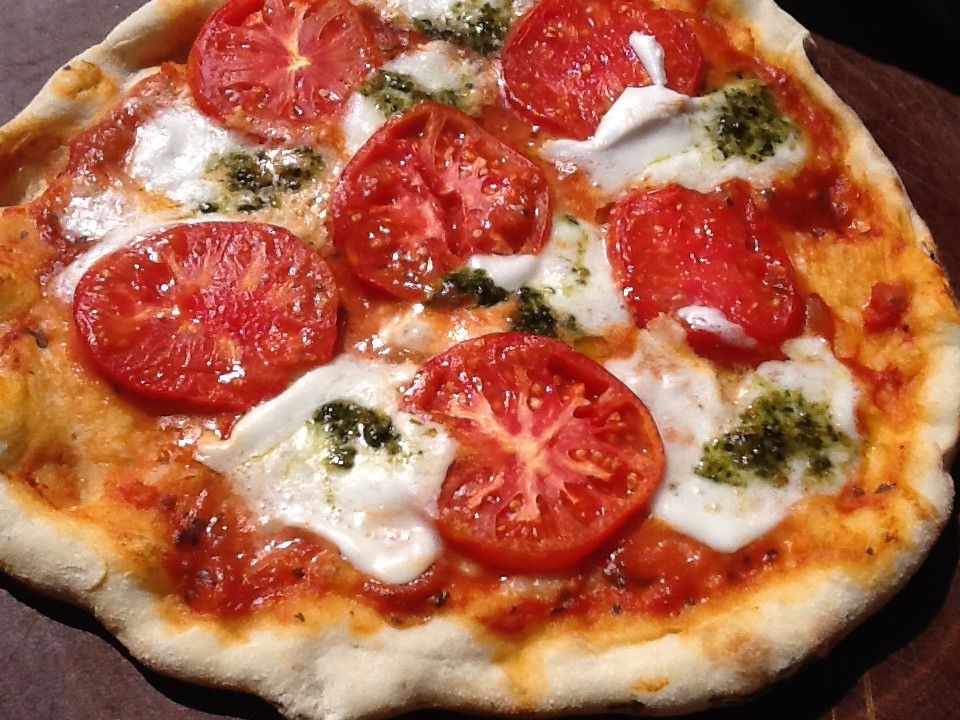
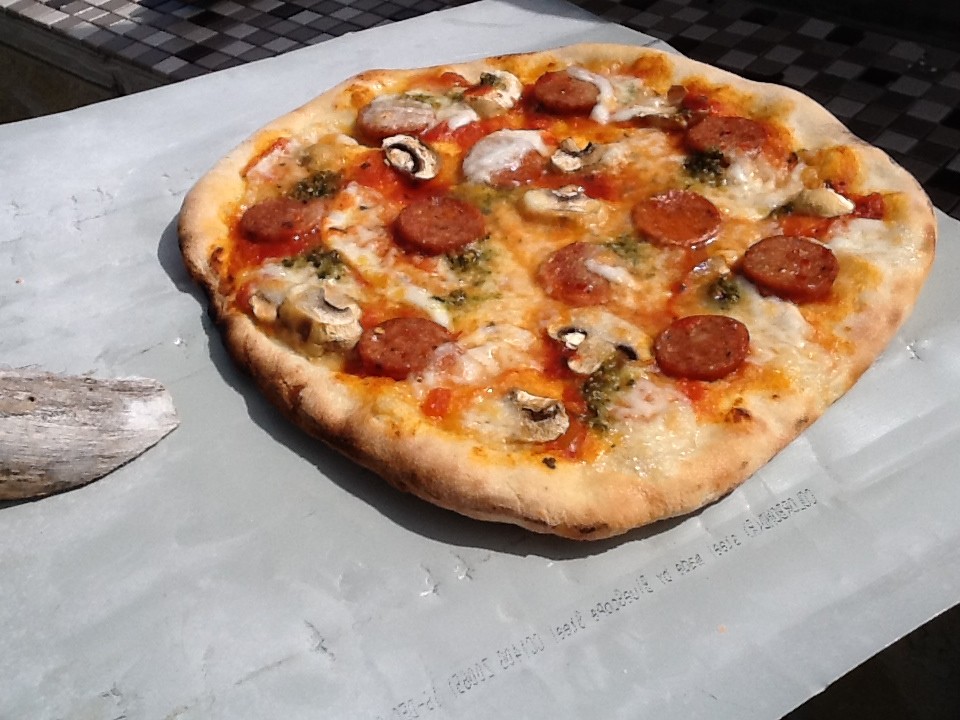
Arrange toppings on pizza – be sparing – less is more. Slide onto stone if using one and bake for about 5 minutes or until golden and crispy. Time will vary depending on your oven. Our outdoor wood-fired oven shown in the photo heats up to over 400°C, so pizzas only take about 3 minutes. In an ordinary oven they can take up to 12 minutes. Keep an eye on it.
Makes one very large or two medium pizzas
Topping suggestions:
Tomato sugo (sold in jars to go with pasta) with thinly sliced mushroom, sliced pepperoni or chorizo and grated mozarella
Pesto with sliced fresh buffalo mozarella and sliced fresh tomatoes
Pesto, peeled prawns, grated mozarella and pine nuts
One of my favourite places to lunch with friends is at the Palette Cafe, located in the Beaver Galleries in Deakin. They are not open in the evening and are closed on Mondays.
In the warmer months my favourite dish was the avocado and smoked salmon salad served on a spicy gazpacho-style tomato sauce. It’s so good, I can’t tell you how many times I’ve ordered it! One of my friends always has the brains with crispy bacon, which she says are to die for. I have been there umpteen times and never had a bad meal. We went there for Mother’s Day brunch and it was excellent. Anyone who can make scrambled or poached eggs which are as good as the ones you make yourself wins my vote. Hats off chef, Meaghan Pidd.
I recently ate one of Meaghan’s delicious lamb pies, served on a bed of sauteed mushrooms, so I decided to make something similar. Eight pies might be too many but you could do as I did – bake four and freeze the rest, then just make half the mushroom mixture. While meat pies are not for those trying to cut down on cholesterol, on a cold winter’s day they just hit the spot!
About 7 sheets of ready-rolled bought puff pastry
1 egg, beaten Filling for Pies:
1 Tbs olive oil
25g butter
1 medium onion, finely chopped
2 cloves garlic, crushed
1 kg lean lamb e.g. leg, shoulder (weight after trimming)
1 cup white wine
1 Tbs brandy
1 tsp sugar
1 tsp dried thyme or 1 Tbs fresh, chopped
½ a chicken stock cube
1 Tbs Dijon mustard
salt and freshly ground black pepper to taste
3 heaped tsp cornflour mixed with 2 Tbs water Mushrooms:
500g button mushrooms
50g butter
¼ cup sherry
1 Tbs Dijon mustard
salt and freshly ground pepper to taste Herb Butter:
¼ cup parsley sprigs
1 small clove garlic, crushed
125g butter at room temperature
Pinch of salt if using unsalted butter
Heat oil and butter in a large heavy-based pan and add the onion and garlic. Cook gently, stirring often, until soft but not browned. Cut the meat into 2cm cubes and add to the pan. Turn up the heat and cook, stirring continuously, until the meat starts to brown. Add the brandy and continue to stir as it evaporates. Add remaining ingredients apart from cornflour mixture. Simmer until meat is tender. This will depend on the meat, but shouldn’t take long. If there’s not enough liquid, add a dash of water. When meat is tender add cornflour mixture, stirring until the sauce thickens. Cool, then refrigerate several hours or overnight.
Cut sixteen circles of pastry about 15cm in diameter using a saucer or bowl to cut around. You may only get one per sheet of pastry, then you will need to gather the trimmings, re-roll and cut the rest. Divide meat filling amongst 8 of the circles, leaving 2cm around the edge. The gravy will have thickened, so it can all be used. Dampen edges of pastry circles, place another circle on top. The tops will seem too small, but if you go round squeezing the edges together they will stretch to fit. You will end up with 8 flying saucer shaped pies. Invert them onto a baking tray lined with baking paper. They can be refrigerated at this stage for up to 24 hours, covered, or frozen for up to a month.
Preheat oven to 180°C. Thaw pies if frozen. Brush with beaten egg. Bake for 30 minutes or until golden brown. Serve on a bed of mushrooms with a slice of herb butter on the side.
Mushrooms: wipe mushrooms and cut into quarters, or eighths if they are larger. Heat butter in a non-stick frying pan and cook mushrooms, stirring, until slightly softened. Add sherry and mustard. Cook for a minute or two to evaporate some of the liquid, then season to taste.
Herb Butter: place herbs in food processor and chop very finely. Add butter, garlic and salt and process to mix well. Scrape out onto a piece of plastic wrap. Use the plastic to form butter into a small log about 2cm in diameter, wrap in the plastic wrap and refrigerate for several hours or overnight. It will keep for two weeks in the fridge.
This recipe first appeared in the Australian Women’s Weekly Big Book of Beautiful Biscuits when it was published in 1982. I’ve been making it ever since and it’s always popular.
The original recipe uses 2 cups fruit mince (mincemeat) but I use a cup of dried fruit and a cup of jam instead. It’s great for using up all those bits of jam and marmalade at the bottom of jars – something my family say I’m famous for. It’s always a great achievement when you can find things in the fridge which need using up and turn them into something finger lickin’ good.
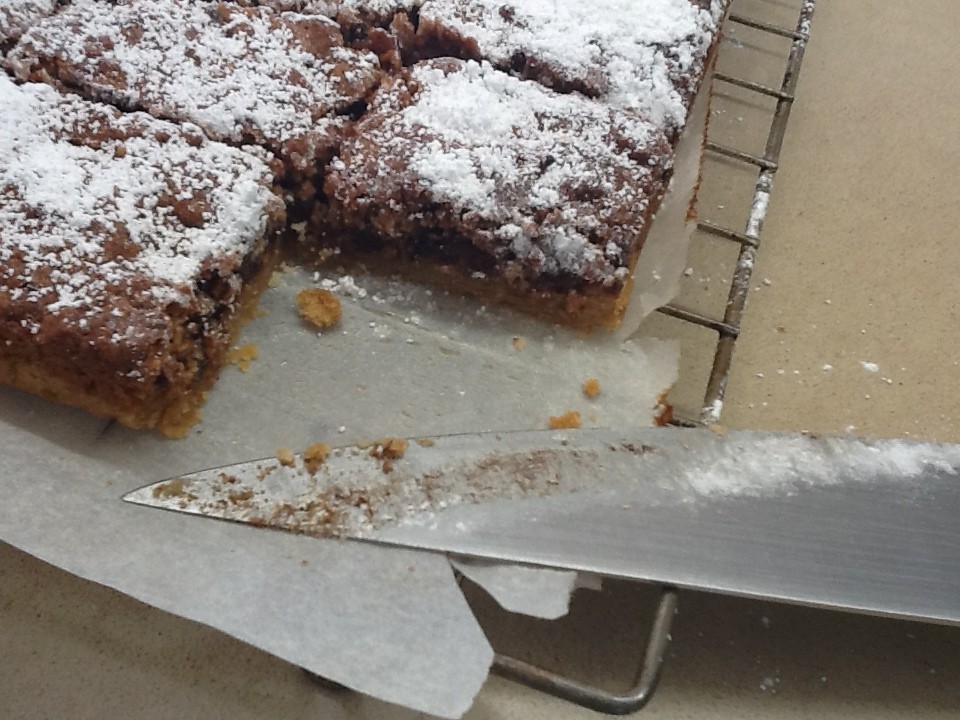
When I returned to take the photo someone, who shall remain nameless and blamed the dog, had already eaten a piece.
Base:
180g butter at room temp
2/3 cup brown sugar, lightly packed
2 cups plain flour Topping:
4 eggs
1 cup brown sugar, firmly packed
2 tsp vanilla essence
2 Tbs Plain flour
1 tsp Baking Powder
3 cups dessicated coconut
1 cup jam (any flavour)
1 cup dried fruit
Preheat oven to 180°C. Process butter and sugar in food processor until creamy. Add sifted flour and mix until you have crumbs which are starting to stick together. Press mixture into a greased Swiss Roll tin or slice tin (mine is 35x25cm) lined with baking paper. It doesn’t have to look very smooth but it does need to be evenly spread to cover the base. Bake for 10 mins or until golden.
Process eggs, sugar and vanilla in food processor. Add coconut, jam and fruit and process just enough to mix. Spread topping over the cooked base, bake for 25-30 mins or until firm and golden brown. Cool, dust with sifted icing sugar and cut into squares.
Variation: Frangipane Bars: make the base as above. When cooked, spread with about a cup or so of raspberry jam or lemon curd. For the filling mix 125g butter, softened, with 1 cup caster sugar in food processor until light and fluffy. Add 4 eggs, ¼ cup plain flour, 3 cups almond meal (or another ground nut) and a tsp of vanilla or almond essence. Spread evenly over the base, sprinkle with flaked almonds and bake for 25-30 mins or until firm and golden brown.
This recipe is based on one by Neil Perry. The original recipe only had half a cup of chicken stock. I added extra liquid to make it more of a soupy stir-fry. I also added a touch of sugar – as per my grandmother’s rule of always adding some sugar to anything savoury and some salt to anything sweet – and some ginger.
It’s a delicious, light and easily-digested supper which takes no time at all to make. If you don’t like squid (which I bought in Woolies) just increase the chicken.
2 Tbs oil
3 boneless chicken thighs, thinly sliced (or 2 breasts)
2 cloves garlic, crushed
1 beaten egg
250-300g fresh rice noodles (I used 220g pack of Kan Tong Shelf Fresh)
3 Tbs soy sauce
1 cup chicken stock
1 squid tube, cut into thin rings
1 bunch Chinese greens e.g. Bok Choy, washed and thickly sliced
2 cups beansprouts
salt and freshly ground pepper to taste
1 tsp sugar
1 Tbs grated fresh ginger To serve:
¼ cup crushed roasted peanuts
2 spring onions, finely sliced on the diagonal
Heat oil in a wok and stir fry chicken for 3-4 minutes, then remove with a slotted spoon. Add garlic and cook for a minute, stirring, then add the egg. Continue to stir-fry as you add the noodles, soy sauce and chicken stock. Return chicken to the pan with squid, ginger and greens and continue to stir-fry for 2 minutes or so. Don’t overcook or the squid will be tough. Add sugar, season to taste and at the last minute add the beansprouts, plus a little more water if necessary. Serve in shallow bowls garnished with the peanuts and spring onions.
When I was at school in England we made Russian Fish Pies in cookery classes. Steamed white fish, chopped hard boiled eggs and parsley were mixed with a thick white sauce, encased in puff pastry and baked. At the time I thought it was delicious, but I now realise that the fish was over-cooked.
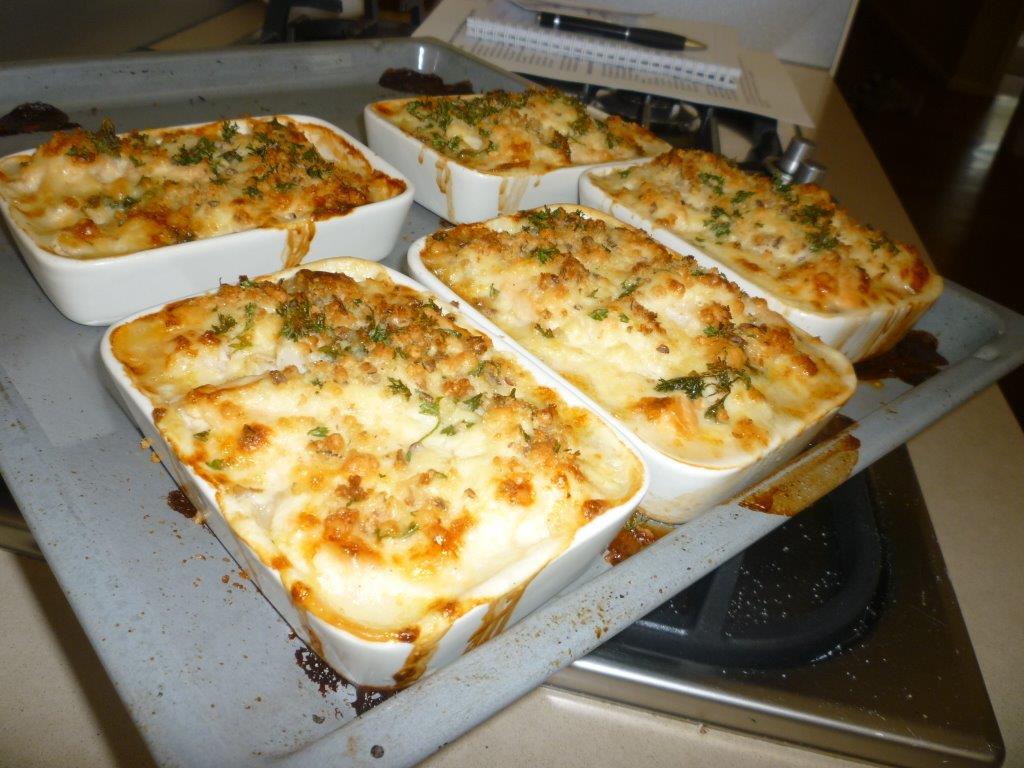
This recipe for Seafood Mornay uses raw seafood mixed into a thick sauce flavoured with cheese and sherry. Either top it with grated cheese and breadcrumbs or make it into pies. Both are delicious – the latter a bit more filling, but not too bad as they only have pastry on the top, not underneath. Either way the seafood is cooked al dente, the way it should be.
500g firm white fish fillets, no skin or bones 500g salmon fillets, no skin or bones 500g peeled raw peeled prawns 3 Tbs breadcrumbs (about one slice of bread whizzed in food processor) 3 Tbs grated Parmesan cheese 2 Tbs parsley Sauce: 60g butter 60g plain flour (about 2 very heaped Tbs) 1½ cups milk ½ cup cream salt and pepper to taste pinch of nutmeg 2 Tbs sherry 150g Gruyere cheese, grated (you can substitute cheddar or Ementhal)
Cut fish into cubes about 2-3 cm square then place with prawns in a colander to drain while you make the sauce. Melt butter, add flour, cook for a minute then gradually add sherry, milk and cream. Add salt, pepper, nutmeg and cheese. Season generously because the seafood hasn’t been seasoned. Remove from heat as soon as cheese melts. The sauce will be very thick, but the fish will create juices as it cooks, especially if it’s been frozen, so you need a thick sauce to counteract this. If it seems unmanageably thick add a dash more milk. Mix sauce with seafood and place in one large buttered ovenproof shallow dish or 8-10 individual dishes.
Preheat oven to 200°C. Mix Parmesan, breadcrumbs and parsley and sprinkle over. Mornays can be refrigerated, covered for up to 24 hrs or frozen, well-wrapped, for up to 2 months. If frozen, thaw before cooking.
Bake for 30-40 mins until golden brown all over and bubbly. Serve as a main dish with a green vegetable such as beans or snow peas and rice or new potatoes.
Serves 8-10
Seafood Pies
Seafood mixture (see above)
1 egg, beaten Sour Cream pastry:
250g plain flour
125g butter
1/3 cup sour cream
1-2 Tbs cold water
1 tsp salt
Place flour in food processor, add cold butter cut into pieces and process until fine crumbs. Add sour cream and salt and start motor again. Gradually add water through the chute with motor running. As soon as pastry forms a ball tip out and pat into a flat disc. Wrap in plastic wrap and refrigerate until needed.
Preheat oven to 200°C. Divide fish mixture amongst 8-10 buttered dishes, such as soufflé dishes shown in photo which have a one cup (250ml) capacity. Fill almost level with the top. Roll out pastry on a floured surface and cut circles the diameter of dishes plus 2-3cm. Dampen edges of dishes, place pastry circles on top and press pastry on to seal. Cut a hole for steam to escape. Brush with beaten egg then bake for 30-40 mins or until golden brown and bubbling through the steam vent.
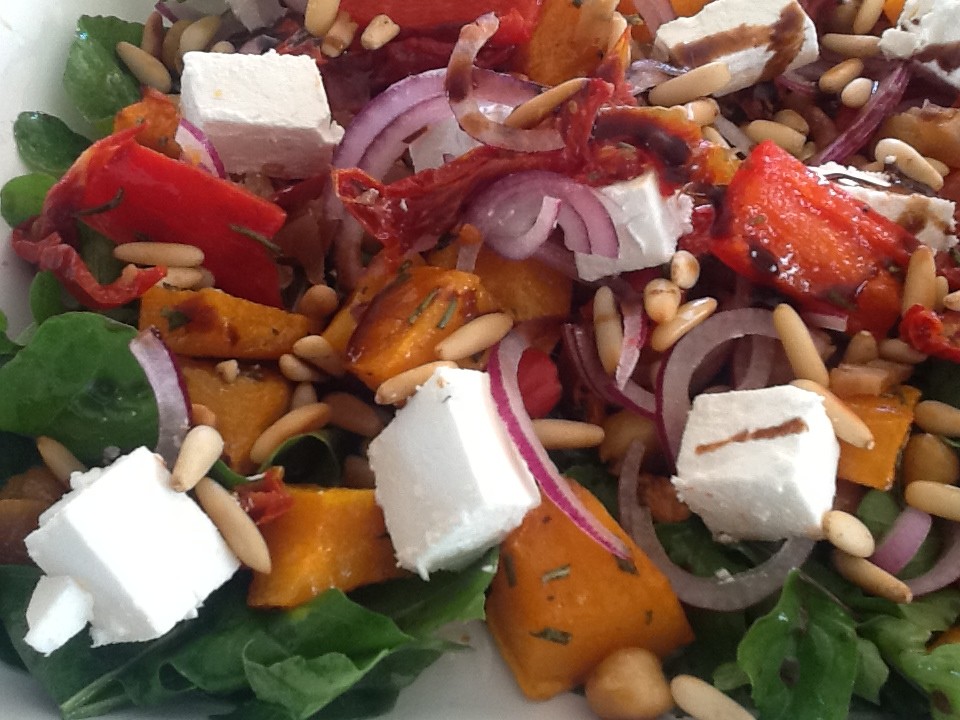
My daughter-in-law Amy created this tasty salad. I’ve added the rosemary and semi-dried or sun-dried tomatoes, which are both optional additions. It makes a perfect weekend lunch with some crusty bread and maybe a glass of Sauvignon Blanc.
Preserved lemons are a Middle Eastern ingredient which you can buy in specialty shops. They are quite easy to make and I will post the recipe in due course.
About 4 cups 2cm square pumpkin cubes
1 red capsicum (pepper) cut into 2-3cm cubes
1 can chick peas, rinsed and well-drained
Extra virgin olive oil
1 Tbs fresh rosemary, finely chopped
Salt and freshly ground black pepper
4-6 cups rocket, washed and dried
Balsamic vinegar
½ small red onion, finely sliced
1-2 Tbs preserved lemon, rinsed, pulp discarded, finely chopped
200g feta cheese, cut into 1.5cm cubes
½ cup semi-dried or sun-dried tomatoes thinly sliced (optional)
3 Tbs pine nuts, lightly toasted
Preheat oven to 200°C. In a bowl mix pumpkin, capsicum and rosemary. Drizzle generously with olive oil and season to taste. Spread out on an oven tray lined with baking paper (to save on washing up!) and bake for 15-20 mins or until vegetables are tender and starting to blacken a bit at the edges. Add chick peas to oven tray for the last few minutes of cooking and stir to coat with oil.
Remove from the oven and allow to cool a bit. Dress rocket with oil and vinegar and arrange on a serving platter or 4 individual plates. Top with the roasted pumpkin mixture, red onion, preserved lemon, feta, dried tomatoes and pine nuts. Drizzle with a little more oil and serve.
When we were growing up my brother, sister and I spent many happy summer holidays on a dairy farm on the moors of County Durham in the far north of England, not far from Barnard Castle. Hill House was run by my Dad’s Uncle Hector and Auntie Vina, their youngest son Ian and his wife Mary. Sometimes we went with my parents, other times we travelled the 300 miles on our own by train and Mary would meet us in Darlington. Ian’s brothers and sisters all had farms and we spent time with all of the rellies. Dent Gate farm had a stream with trout in it. If we were patient we could catch them by tickling them. Don’t believe me? Well neither does Matthew, but it’s true!
Cakes were a staple part of a farmer’s diet back then. They were served with morning tea at eleven and afternoon tea was a proper sit down affair back then. On Sundays they really went to town. The first time I saw the table groaning under the weight of a huge selection of cakes, sweet pastries, cold meats, chutneys, jellies, trifles and fruit salad, I couldn’t believe my eyes. Down south where I came from we were lucky if we had one home-made cake to choose from!
One day a week was set aside for baking in the temperamental wood-fired Aga stove. You couldn’t adjust the temperature and had to cook according to how hot the oven was that day. On windy days the oven would be hot and we would make blackberry and apple pies, using wild blackberries we had collected ourselves. If there was no wind the oven would be cooler and we made fruit cakes.
When I won first prize for a two egg sponge in the Butterknowle annual show I was tickled pink – but it was all thanks to Auntie Vina’s foolproof recipe. She had a huge influence on my love of cooking, teaching me all the basic skills and recipes for cakes and pastries. This Rum and Raisin cake is adapted from one of her recipes. I’ve added the cottage cheese and a bit more rum.
I never let the lack of an ingredient stop me making something, so you will see I’ve listed some substitutions below.
Ian and Mary have retired and in the family tradition Hill House is now being run by their son Jonathon and his wife Fay. It’s no longer a dairy farm as they lost all their cattle in the Foot and Mouth outbreak of 2001 and had to start over again.
1½ cups raisins
½ cup dark rum
125g butter, at room temp
1 cup brown sugar, firmly packed
3 eggs
1/3 cup milk
300g cottage cheese or ricotta
¾ cup ground almonds
1¼ cups self-raising flour, sifted
Icing sugar
Soak raisins in rum several hours or overnight. Preheat oven to 170°C. Line a cake tin with baking paper. I used a 22cm (9″) square tin, but a round one will do. In food processor or in a bowl with electric beaters mix butter and sugar until creamy. Add eggs, milk and cottage cheese and mix well, stopping to scrape down the sides halfway. Add ground almonds and self-raising flour. Stop and scrape down, add raisins and rum and mix just enough to incorporate as you don’t want to chop the raisins. Scrape into tin and smooth the top. Bake for 40-60 mins or until evenly browned, firm to touch and a skewer inserted in the middle comes out clean. Cool then tip out, remove paper, dust with icing sugar and cut into squares or rectangles to serve.
Makes about 20 pieces
Note: you can make your own ground nuts in the food processor.
Substitutions: brandy instead of rum, sultanas or other dried fruit instead of raisins, white sugar instead of brown, ground hazelnuts or walnuts instead of almonds.

 1 ripe banana
 pizzas